
In the era of new materials, as traditional materials like wood, iron, and concrete gradually reveal their limitations in terms of durability, weight, and environmental resistance, Composite materials It has emerged as a groundbreaking solution. Dubbed the “material of the future,” composites are playing a key role in every field, from sophisticated interior architecture to aerospace technology. In today's article, Vieto Life We will help you thoroughly decipher this material and analyze why it has become the preferred choice for modern construction projects in 2026.
Index
1. What are composite materials? Definition and origin
1.1. The concept of science
Composite materials (or composite materials, composite materials) are materials created from two or more different materials with completely different physical and chemical properties, combined to create a new material with superior properties compared to the original components. Most importantly, these components do not dissolve into each other but are only physically or chemically bonded to form a unified whole.

1.2. History of Formation
The concept of composites has existed since ancient times, when people used mud mixed with straw to make stronger bricks. However, the modern concept of composites only truly boomed in the mid-20th century with the advent of fiberglass and synthetic resins, serving the needs of shipbuilding and military equipment. By 2026, composite technology had reached a sophisticated level, allowing the creation of material structures as strong as steel but lighter than plastic.
1.3. Basic Structure
The structure of a typical composite material system consists of discontinuous phases (reinforcement components) surrounded by a continuous phase (matrix component). This combination maximizes the strengths of each component, overcoming the disadvantages of individual materials.
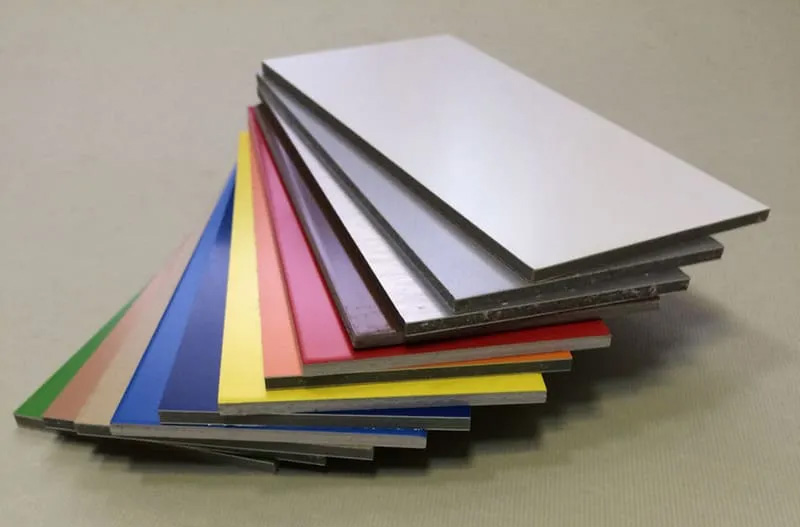
2. Detailed composition of composite materials
To understand why composites are so highly customizable, we need to look at their internal structure:
2.1. Fiber component
This is the main load-bearing component, providing the material with stiffness, tensile strength, and load-bearing capacity. Common reinforcing materials include:
- Fiberglass: Low cost, high durability.
- Carbon Fiber: Ultra-lightweight, superior rigidity, suitable for high-tech applications.
- Aramid fiber (Kevlar): Excellent impact resistance, used for protective armor.
- Wood powder, stone powder: Commonly used in interior composite materials.
2.2. Matrix Components
This component plays a role in connecting the reinforcing phases together, protecting them from environmental effects, and distributing the load evenly. The foundation is usually:
- Plastic base: Polyester resin, epoxy resin, phenolic resin, thermoplastic resin.
- Metal base: Aluminum, titanium, copper.
- Ceramic base: These materials are extremely heat-resistant and strong.
2.3. Additives
These are the "ingredients" that give materials additional special properties such as fire resistance, UV resistance, antistatic properties, increased hardness, color, or increased resistance to chemical abrasion.
3. Outstanding advantages that help composite materials replace traditional materials.
3.1. Extremely high mechanical strength
Composites have a significantly higher strength-to-weight ratio than metals. They do not deform under high pressure and can withstand extremely high tensile, compressive, and bending stresses.
3.2. Ultra-lightweight
If you compare a composite panel to a natural stone slab of the same size, the composite panel is many times lighter. This not only reduces transportation costs but also protects the building structure, making construction at height safer than ever.

3.3. Corrosion and chemical resistance
This is a crucial advantage in harsh environments. Composites do not rust like iron and steel, do not rot like natural wood, and are not altered by acid, alkali, or sea salt solutions.
3.4. Excellent electrical, thermal, and sound insulation.
Composites are natural insulators and poor conductors of heat. This makes them ideal materials for electrical appliances and interior decorative items that require heat retention.
4. Classification of common composite materials on the market
4.1. Resin-based composites (Most common)
This is the dominant material in industrial manufacturing and interior decoration. Resin-based composites (such as fiberglass-reinforced plastic – FRP) are highly versatile, easy to mold, and cost-effective to produce.
4.2. Wood-Plastic Composite (WPC)
This is a major step forward for the interior decoration industry. WPC is a combination of wood powder (wood fiber) and plastic granules. It retains the natural beauty of wood but completely eliminates concerns about termites, warping, and water absorption.

4.3. Metal and ceramic composites
This series is primarily used in aviation, spacecraft, and heavy industries where extreme heat resistance and incredible rigidity are required.
5. Diverse applications of composite materials in daily life.
5.1. In the construction and interior design industry
Composites have transformed the face of modern architecture with products such as: Nano cladding panels, exterior wall cladding, fireproof doors, decorative wave-shaped louvers, faux stone tables and chairs, decorative art sculptures, etc. It allows architects to freely create complex shapes that were impossible with traditional materials.

5.2. In the transportation sector
Thanks to their lightweight nature, composites are used in the production of aircraft fuselages, ship hulls, and Formula 1 racing car bodies, helping vehicles consume less fuel and operate faster.
5.3. In sports and recreation
From tennis rackets and fishing rods to skateboards and stadium equipment, carbon fiber composites are used to optimize performance and durability.
5.4. In the energy industry
Wind turbine blades are one of the greatest applications of composites, enabling the creation of massive, highly durable blades capable of withstanding extremely strong ocean winds.
6. Evaluating Composite Materials: Are They Really as Good as They Say?
6.1. Advantages
- Absolute flexibility: It can be cast into any shape, from simple to complex.
- Ultimate durability: Long lifespan, requires little maintenance.
- Aesthetics: It is possible to create perfect imitation stone, wood, and metal finishes and colors.
6.2. Disadvantages
- Difficult to recycle: Due to their strong bonding properties, composites are more difficult to recycle than single-component metals or plastics.
- Initial cost: Even with high-end composite materials (such as carbon fiber), the cost of raw materials and manufacturing technology remains high.
- Construction knowledge: It requires installers to have a thorough understanding of the technical characteristics of each type of adhesive and screw to ensure durability.
7. So, should composite materials be used for wall cladding?
Despite being known for its high durability, composite materials used in wall cladding still exhibit several drawbacks, such as: their considerable weight puts pressure on the structure, their poor elasticity makes installation difficult in curved areas, and the cost of materials and labor for installation is often high. More concerningly, some low-quality composite materials may emit toxic gases and are highly flammable, posing a risk to the construction.
To thoroughly address these issues, Viecolife soft stone cladding has emerged as a perfect alternative with revolutionary advantages:
-
Ultra-lightweight and easy to install: With its flexible structure and extremely light weight, Viecolife soft stone makes transportation and installation simpler than ever. You can easily cut and apply it to any surface, including complex bevels or round columns, without the need for bulky machinery.
-
Cost-effective: The product helps investors save significantly on their budget thanks to its competitive price and minimal reduction in labor costs and construction time.
-
Absolute safety for health: Viecolife is committed to providing products that are formaldehyde-free and odorless, ensuring complete peace of mind for your living space, especially for families with young children.
-
Fire resistance level A1: Unlike conventional plastics or composites, Viecolife soft stone meets the highest fire resistance standard (level A1), helping to prevent the spread of flames and protect the homeowner's ancestral property.
Choosing Viecolife soft stone is not only choosing the natural beauty of the stone, but also choosing a sustainable solution for health and safety in all construction projects.
Share
KENMEC VIETNAM CO., LTD.
Group: 0374.955.566
E-mail: Salesvn@kenmec.com
Address: Thach That - Quoc Oai Industrial Zone, Tay Phuong Commune, Hanoi City